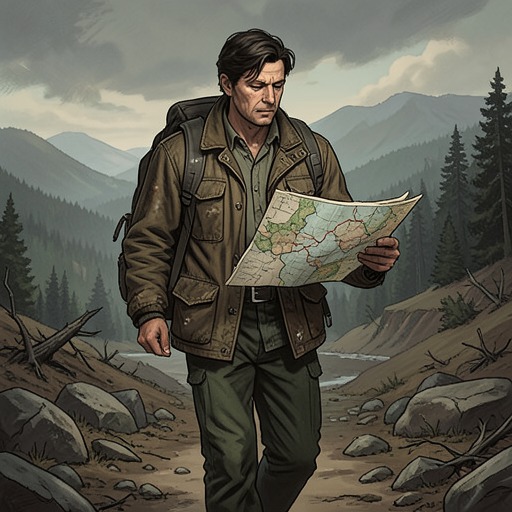
Perry’s physical disability after the motorcycle accident
In Cold BloodPerry’s physical disability after the motorcycle accident was not a brief obstacle that vanished when the immediate crisis ended: it shaped a year of recovery, altered his prospects for heavy-equipment work, and made him self-conscious about exposing his legs. The account connects those limits to a larger change in his life, from the reckless speed his father remembered to a more cautious outlook, without treating recovery as either complete restoration or simple defeat.
The Crash and Its Aftermath
In 1952, after completing his military service, Perry set out for Alaska to join his father, Tex John Smith, who was preparing to build a hunting lodge. He had bought a motorcycle while stationed at Fort Lewis. On the journey north, near Bellingham, the motorcycle skidded on a rainy road. The account identifies the crash as the beginning of a delay that would keep father and son apart for a year.
Surgery and hospitalization occupied six months of that year. Perry spent the remaining months recuperating in the forest home of Joe James, a young logger and fisherman, and Joe’s family. On crutches and largely dependent on their care, Perry was, by his own account, almost helpless. His physical condition restricted what he could do day to day, but the family’s hospitality gave him a place to recover and a way to contribute while he could not return to ordinary work.
Recovery in Joe James’s Home
Perry began an informal school for Joe James’s children and some of their friends, holding classes in the parlor. He taught harmonica, guitar, drawing, and penmanship, and helped the children read stories by correcting them as they took turns. He described this period as enjoyable and said he liked children. The classes turned a period of dependence into one in which he could offer skills and attention, even while crutches and pain limited his movement.
As spring came, Perry could walk, though walking still hurt. The gradual return of mobility allowed him to leave the household and continue to Alaska; it did not erase the year lost to the crash or the physical difficulty of recovery. His father had waited for him, and the reunion led into their joint work on the proposed lodge. They built it together, with occasional help from an Indigenous worker, and opened for business at the end of 1953. The sequence shows Perry returning to strenuous activity after the accident, but does not establish that his injuries had ceased to affect him.
Work, Speed, and Changed Prospects
The accident mattered in part because Perry’s preferred work depended on physical ability. His father described him as mechanically inclined and especially drawn to bulldozers, draglines, shovels, and heavy trucks. In a later account, the father understood Perry to be confronting a narrower future: contractors would not generally hire a disabled worker for heavy-equipment jobs unless they already knew him. Perry was beginning, his father believed, to consider an easier way to support himself, closer to the self-directed life his father had pursued.
His father also linked the injuries to a change in Perry’s attitude toward speed. Before the crash, Perry had been reckless with motorcycles and cars. After breaking both legs and injuring his hip, he appeared to his father to have learned what speed could cost and to have lost some of its appeal. The father drew particular meaning from Perry’s letters, which now advised him not to drive when sleepy and to stop and rest. Advice once given by father to son had been reversed. The letters do not prove that Perry had become free of risk-taking, but they let his father read caution as evidence of a lasting lesson.
The Injured Body and Social Self-Consciousness
The injuries also affected how Perry presented himself. In a scene aboard the Estrellita, he was willing to sit for Otto’s sketch, but remained uncomfortable about exposing his legs. Although he had talked about skin-diving and imagined himself underwater, he had not gone into the water. He feared that people would be disgusted by the sight of his injured legs, and so kept his trousers on rather than wear swimming trunks. The evidence describes anticipated judgment, not an actual response from others; the distinction matters. The limitation was physical, but his withdrawal from swimming was also bound up with what he imagined other people would see.
Otto’s drawing was a likeness of Perry seated bare to the waist, reproducing tattoos across his chest and arms while leaving his legs covered. The sketchbook also included drawings of Dick and became a parting gift. Its partial portrait gives the scene a quiet visual boundary: Perry could be represented, even closely, without showing the part of his body that caused him shame. His reluctance to swim and his willingness to be drawn are not contradictory so much as different degrees of control over exposure.
Disability Within Perry’s Life Story
Across these episodes, disability appears through practical circumstances rather than as a single medical label: the crash and surgery, crutches and painful walking, dependence on a welcoming household, reduced access to the work he wanted, and hesitation about public exposure. The same account records forms of agency that remained available to Perry. He taught children, resumed the journey to his father, and took part in building the lodge. These details do not cancel the restrictions or establish a full recovery; they show that his capacity and his limitations existed together.
His father’s interpretation gives the injuries a further consequence. He saw Perry’s altered career prospects and cautions about driving as signs that speed had taught him a lesson. Yet Perry’s own reported experience at the time of recovery is more immediate: walking hurt, and for months he needed other people’s care. Read together, the accounts resist a clean transformation in which an accident simply reforms its survivor. The bodily consequences persisted in work, movement, and self-presentation, while Perry continued to find ways to act, contribute, and make a life within changed circumstances.